Thursday, February 28, 2019

Rent-A-Center Earnings: RCII Stock Soars as Q4 EPS 15c Above Guidance

Rent-A-Center (NASDAQ:RCII) reported a strong quarterly showing for its fourth quarter that included earnings, revenue and same-store sales that came in better than what Wall Street was calling for, sending RCII stock up more than 5% after the bell.

Rent-A-Center EarningsRent-A-Center Earnings Source: Flickr

Based out of Plano, Texas, the rent-to-own business ended its fiscal 2019 with quarterly net income of $1.7 million, or 3 cents per share. The figure may have been a fraction of its year-ago profit of $34.8 million, or 65 cents per share, but this piece of data did not tell the whole story.

On an adjusted basis, Rent-A-Center tallied up earnings of 35 cents per share, besting the 20 cents a share that Wall Street called for, according to the FactSet guidance.

The furniture and electronics renting service provider raked in revenue of $661.8 million for its fourth quarter, about 3.6% better than the $638.9 million that analysts projected. Analysts were looking at revenue of $655 million for the period, per FactSet.

Another important metric for Rent-A-Center is its revenue from rentals and fees, which popped about 3.8% to $565.2 million year-over-year, topping the $556 million that FactSet forecasted. Consolidated same-store sales were up by 9.1%, beating the 8.7% that analysts called for.

For its fiscal 2019, the company predicts that it will save costs on certain initiatives that were rolled out in 2018. Plus, it will reduce 2019 expenses by $50 million compared to last year.

RCII stock was down 1.1% during regular trading on Monday, but is now up close to 5.7% after hours as a positive earnings report on all fronts proved to be beneficial for investors heading further into 2019.

Compare Brokers

Tuesday, February 26, 2019

3 Dividend Stocks That Are Actually Worth Owning

This is the time of year, and the time of my life, when it pays to talk about dividend stocks.

Capital gains are great, but dividends will bring you income without destroying your principal. The key is to hold these shares for the long term and let your effective yield rise with them.

While conventional wisdom holds that you reach for yield, my strategy has been to look first for capital gains, then to management teams that are committed to a payout and finally let time do its magic. You may buy a $50 stock with a 2% dividend, but if that dividend then doubles over the course of several years, and the stock price doubles as well, the effective yield on that $50 investment becomes 4%.

There are risks here. If management is lying to itself about the company’s prospects, it may all collapse, as happened with General Electric (NYSE:GE). If your investments are on the lagging side of the economy you may wind up holding a capital loss, as with Macy’s (NYSE:M) or Kraft Heinz (NYSE:KHC). You must pay attention.

But here are three dividend stocks that are in my portfolio now, that have been for some time and which are doing very well for me.


Compare Brokers
Microsoft (MSFT) Microsoft (MSFT) dividend stocksMicrosoft (MSFT) dividend stocksSource: Shutterstock

I avoided Microsoft (NASDAQ:MSFT) shares while Steve Ballmer was CEO. He was a great salesman, but he wasn’t a technology visionary.

But after writing several stories about his successor, Satya Nadella, I was impressed enough to take a chance. I’m very glad I did. Nadella has doubled my money, and Microsoft today is the most valuable company in the world, with a market cap on Feb. 21 of $822 billion.

Nadella’s Microsoft has steered clear of the twin rocks of power and fame. The company is no longer under Justice Department scrutiny over its Windows or Office “monopoly.” The Google unit of Alphabet (NASDAQ:GOOG, NASDAQ:GOOGL) provides plenty of competition, thanks to Android, Chrome and the G Suite of apps.

Microsoft Azure doesn’t even have the leading share in cloud. Amazon (NASDAQ:AMZN) does. But Azure is a more profitable cloud, a platform on which enterprise applications can be built, and through which they can serve a global audience. Instead of eating its ecosystem, as Oracle (NASDAQ:ORCL) was accused of doing, Microsoft is building an ecosystem of increasingly wealthy partners like Adobe (NASDAQ:ADBE).

The MS in MSNBC still stands for Microsoft, but that news network all belongs to Comcast (NASDAQ:CMCSA) now. Nadella’s Microsoft avoids the media spotlight, it talks softly but carries the big technology stick. Its current dividend of 46 cents per share, up from 28 cents per share five years ago, carries a yield of just 1.6% at current prices, but if you bought when I did, when the stock was priced at around $50 per share, that yield is closer to 3.6%. Such is the magic of time.


Compare Brokers
Charles Schwab (SCHW) Charles Schwab (SCHW) dividend stocksCharles Schwab (SCHW) dividend stocksSource: Mike Mozart via Flickr (Modified)

Charles Schwab (NASDAQ:SCHW) is my banker and my broker.

I used to call Schwab my bookie. If I had a hot tip on a stock, I’d tell friends I was calling “Charlie” to put a few bucks on its nose.

Schwab began as what was called a “discount broker.” It didn’t tout stocks. It took orders, processed them online and accounted for its clients’ “bets.” But it has ridden that trend to a market cap of $62.7 billion, against $75.4 billion for Goldman Sachs (NYSE:GS).

The dividend yield on Schwab’s current dividend of 17 cents per share comes to just 1.44%, but the dividend was just 6 cents five years ago, and the shares have doubled in value. That’s how you make money. I have magnified the impact of that dividend by taking it in stock rather than cash, so the dividend’s value to me has increased along with the stock price.

Schwab has expanded its reach slowly and steadily as technology has improved, so that my daughter now gets a managed portfolio of mutual funds, my wife has a bank card that repays its ATM fees and I can get an instant update on my portfolio whenever I want.

Charles Schwab himself is 81 and no longer works at his eponymous company. He doesn’t even appear in its commercials, as he once did. But by sticking to his knitting since founding the company in 1971 he has amassed a personal fortune estimated at $8.5 billion. In the words of a now long-lost competitor, Smith Barney, he did it the old-fashioned way. He earned it.


Compare Brokers
JPMorgan Chase (JPM) JPMorgan Chase (JPM) dividend stocksJPMorgan Chase (JPM) dividend stocksSource: via Wikimedia

JPMorgan Chase (NYSE:JPM) is the largest bank in the U.S. by deposits, with over $2.62 billion. It combines New York City’s two greatest fortunes, the 19th-century investment banking house of J.P. Morgan and the 20th-century commercial banking house of David Rockefeller.

Its current dividend yields 3%, comparable to a 30-year U.S. bond, but the stock’s value has doubled over the last five years and so has the dividend, so investors with patience have been rewarded.

While Jamie Dimon now sits on the Morgan throne, and the throne of the U.S. banking establishment, I give some credit for Morgan’s current success to the Obama Administration, which forced the bank to bulk itself in, rein itself in and submit to regular “stress tests” a decade ago, so that it now has adequate financial strength to handle a future crisis, something few foreign banks can say with confidence.

For any aging investor, safety and security need to be your watchwords, alongside dividend yield. This is what JPMorgan now offers. It should not be the first stock you buy but, if you have a nest egg to protect, it deserves to be in your portfolio.

I don’t hold any stock blindly. I will be listening carefully to whoever succeeds Dimon as Morgan CEO, as I will be listening to future managers at Microsoft and Schwab. A radical change in any company, or in the economy, can force a rethink in this old man’s portfolio. Don’t fall in love with your stocks.

But as I sail toward retirement, I’m comfortable with the investment hand I have, and these are some of my hole cards.

Dana Blankenhorn http://www.danablankenhorn.com is a financial and technology journalist. He is the author of a new mystery thriller, The Reluctant Detective Finds Her Family, available now at the Amazon Kindle store. Write him at [email protected] or follow him on Twitter at @danablankenhorn. As of this writing, he owned shares in MSFT, SCHW and J

Friday, February 22, 2019

Royal Bank of Canada Reaffirms Average Rating for Emera (EMA)

Emera (TSE:EMA)‘s stock had its “average” rating reaffirmed by analysts at Royal Bank of Canada in a report issued on Wednesday. They presently have a C$53.00 target price on the stock, up from their prior target price of C$50.00. Royal Bank of Canada’s price target indicates a potential upside of 13.93% from the company’s current price.

Several other equities research analysts have also recently weighed in on EMA. CIBC reduced their price target on shares of Emera from C$47.00 to C$45.00 in a research report on Wednesday, October 24th. BMO Capital Markets reduced their price target on shares of Emera from C$48.00 to C$47.00 and set a “buy” rating on the stock in a research report on Friday, November 9th. TD Securities boosted their price target on shares of Emera from C$47.00 to C$48.00 and gave the stock a “buy” rating in a research report on Monday, November 12th. National Bank Financial boosted their price target on shares of Emera from C$43.00 to C$44.00 and gave the stock a “sector perform” rating in a research report on Tuesday, November 27th. Finally, UBS Group upgraded shares of Emera from a “neutral” rating to a “buy” rating and boosted their price target for the stock from C$42.00 to C$51.00 in a research report on Thursday, November 29th. Five investment analysts have rated the stock with a hold rating, four have issued a buy rating and one has issued a strong buy rating to the stock. The stock presently has a consensus rating of “Buy” and an average price target of C$48.09.

Get Emera alerts:

Shares of EMA opened at C$46.52 on Wednesday. Emera has a fifty-two week low of C$38.09 and a fifty-two week high of C$46.77. The firm has a market capitalization of $10.81 billion and a P/E ratio of 42.52. The company has a current ratio of 0.56, a quick ratio of 0.38 and a debt-to-equity ratio of 201.50.

Emera (TSE:EMA) last announced its quarterly earnings results on Tuesday, February 19th. The company reported C$0.71 earnings per share for the quarter, topping the consensus estimate of C$0.63 by C$0.08. The business had revenue of C$1.80 billion during the quarter, compared to the consensus estimate of C$1.61 billion. As a group, analysts anticipate that Emera will post 2.83000010971844 EPS for the current year.

In other Emera news, insider Wayne David O’connor sold 7,100 shares of Emera stock in a transaction on Wednesday, December 12th. The shares were sold at an average price of C$44.37, for a total transaction of C$315,027.00.

Emera Company Profile

Emera Incorporated, an energy and services company, through its subsidiaries, engages in the generation, transmission, and distribution of electricity to various customers. The company is also involved in gas transmission and utility energy services businesses; and the provision of energy marketing, trading, and other energy asset management services.

See Also: What is the Quick Ratio?

Analyst Recommendations for Emera (TSE:EMA)

Thursday, February 21, 2019

$356.99 Million in Sales Expected for PDC Energy Inc (PDCE) This Quarter

Equities analysts expect that PDC Energy Inc (NASDAQ:PDCE) will announce $356.99 million in sales for the current fiscal quarter, according to Zacks. Nine analysts have issued estimates for PDC Energy’s earnings. The highest sales estimate is $378.00 million and the lowest is $346.00 million. PDC Energy reported sales of $189.52 million in the same quarter last year, which indicates a positive year-over-year growth rate of 88.4%. The company is expected to announce its next quarterly earnings results after the market closes on Wednesday, February 27th.

On average, analysts expect that PDC Energy will report full-year sales of $1.14 billion for the current financial year, with estimates ranging from $1.08 billion to $1.27 billion. For the next year, analysts anticipate that the business will post sales of $1.46 billion, with estimates ranging from $1.38 billion to $1.71 billion. Zacks’ sales averages are an average based on a survey of analysts that follow PDC Energy.

Get PDC Energy alerts:

Several research firms have issued reports on PDCE. MKM Partners began coverage on PDC Energy in a research note on Wednesday, December 5th. They issued a “buy” rating and a $67.00 target price on the stock. Imperial Capital reiterated an “outperform” rating and issued a $61.00 target price (up previously from $57.00) on shares of PDC Energy in a research note on Tuesday, February 12th. Williams Capital reiterated a “buy” rating and issued a $62.00 target price on shares of PDC Energy in a research note on Wednesday, December 12th. BidaskClub lowered PDC Energy from a “sell” rating to a “strong sell” rating in a research note on Thursday, December 13th. Finally, BMO Capital Markets set a $55.00 target price on PDC Energy and gave the company a “hold” rating in a research note on Tuesday, November 13th. Three investment analysts have rated the stock with a sell rating, seven have given a hold rating and nineteen have issued a buy rating to the company. The company currently has an average rating of “Buy” and a consensus price target of $62.45.

In other PDC Energy news, Director Anthony J. Crisafio sold 1,500 shares of the firm’s stock in a transaction dated Thursday, January 31st. The stock was sold at an average price of $34.21, for a total value of $51,315.00. The sale was disclosed in a filing with the Securities & Exchange Commission, which is accessible through this link. 1.00% of the stock is currently owned by company insiders.

Several institutional investors have recently added to or reduced their stakes in the stock. Millennium Management LLC lifted its holdings in shares of PDC Energy by 1,092.0% during the fourth quarter. Millennium Management LLC now owns 2,071,379 shares of the energy producer’s stock worth $61,644,000 after purchasing an additional 1,897,607 shares during the period. Legal & General Group Plc lifted its holdings in shares of PDC Energy by 0.3% during the fourth quarter. Legal & General Group Plc now owns 166,815 shares of the energy producer’s stock worth $4,928,000 after purchasing an additional 521 shares during the period. Segall Bryant & Hamill LLC lifted its holdings in shares of PDC Energy by 13.3% during the fourth quarter. Segall Bryant & Hamill LLC now owns 129,300 shares of the energy producer’s stock worth $3,848,000 after purchasing an additional 15,138 shares during the period. Municipal Employees Retirement System of Michigan acquired a new stake in shares of PDC Energy during the fourth quarter worth about $569,000. Finally, Metropolitan Life Insurance Co. NY lifted its holdings in shares of PDC Energy by 365.1% during the fourth quarter. Metropolitan Life Insurance Co. NY now owns 21,392 shares of the energy producer’s stock worth $637,000 after purchasing an additional 16,793 shares during the period.

Shares of PDC Energy stock traded up $1.17 during trading on Friday, hitting $39.26. 1,159,887 shares of the stock traded hands, compared to its average volume of 1,218,409. PDC Energy has a 52-week low of $26.59 and a 52-week high of $66.20. The company has a current ratio of 0.38, a quick ratio of 0.38 and a debt-to-equity ratio of 0.53. The firm has a market cap of $2.53 billion, a P/E ratio of -11.28, a P/E/G ratio of 0.49 and a beta of 0.82.

PDC Energy Company Profile

PDC Energy, Inc, an independent exploration and production company, acquires, explores for, develops, and produces crude oil, natural gas, and natural gas liquids in the United States. The company's operations are primarily located in the Wattenberg Field in Colorado and the Delaware Basin in Texas.

Featured Article: Benefits of owning preferred stock

Get a free copy of the Zacks research report on PDC Energy (PDCE)

For more information about research offerings from Zacks Investment Research, visit Zacks.com

Earnings History and Estimates for PDC Energy (NASDAQ:PDCE)

Wednesday, February 20, 2019

Best Penny Stocks To Buy For 2019

tags:SAFM,CPHI,SORL,UMH,NICK,

Both in the U.S. and internationally, marijuana -- especially the medical variety -- is getting more and more accepted with time. So, how do you invest in it? In this episode of MarketFoolery, host Chris Hill talks with Motley Fool analyst Shannon Jones about how to get exposure to the fledgling industry without buying into the ever-risky penny stocks that make up most of the U.S. marijuana market.

Click play to learn about a few international companies for your marijuana stock watch list, as well as one domestic picks-and-shovels play; the exciting state of medical marijuana in the U.S. today; how growing acceptance of medical marijuana in the sports industry fits into changing views around the drug; and more.

A full transcript follows the video.

<div class="wistia_responsive_padding" style="padding:56.25% 0 0 0;position:relative;"><div class="wistia_responsive_wrapper" style="height:100%;left:0;position:absolute;top:0;width:100%;"><iframe src="https://fast.wistia.net/embed/iframe/mthypcys5f?videoFoam=true" title="Wistia video player" allowtransparency="true" frameborder="0" scrolling="no" class="wistia_embed" name="wistia_embed" allowfullscreen mozallowfullscreen webkitallowfullscreen oallowfullscreen msallowfullscreen width="100%" height="100%"></iframe></div></div> <script src="https://fast.wistia.net/assets/external/E-v1.js" async></script>

Best Penny Stocks To Buy For 2019: Sanderson Farms Inc.(SAFM)

Advisors' Opinion:
  • [By Logan Wallace]

    ValuEngine cut shares of Sanderson Farms (NASDAQ:SAFM) from a strong-buy rating to a buy rating in a research report released on Wednesday morning.

  • [By Shane Hupp]

    Sanderson Farms, Inc. (NASDAQ:SAFM) announced a quarterly dividend on Friday, September 21st, Wall Street Journal reports. Stockholders of record on Tuesday, October 2nd will be given a dividend of 0.32 per share on Tuesday, October 16th. This represents a $1.28 annualized dividend and a dividend yield of 1.29%. The ex-dividend date is Monday, October 1st.

  • [By Lisa Levin]

    Breaking news

    Best Buy Co., Inc. (NYSE: BBY) reported better-than-expected earnings for its first quarter. Sanderson Farms, Inc. (NASDAQ: SAFM) reported weaker-than-expected results for its second quarter. Medtronic plc (NYSE: MDT) reported upbeat earnings for its fourth quarter on Thursday. Williams-Sonoma, Inc. (NYSE: WSM) reported stronger-than-expected results for its first quarter. The company also raised its FY18 earnings and sales guidance.

Best Penny Stocks To Buy For 2019: China Pharma Holdings Inc.(CPHI)

Advisors' Opinion:
  • [By Logan Wallace]

    These are some of the news headlines that may have impacted Accern Sentiment’s scoring:

    Get Scynexis alerts: Steady Activities: SCYNEXIS, Inc. (NASDAQ:SCYX), LPL Financial Holdings Inc. (NASDAQ:LPLA) (oracleexaminer.com) Do Analysts Think You Should Buy – SCYNEXIS Inc (NASDAQ: SCYX) (stockspen.com) Notable Runner: SCYNEXIS, Inc. (SCYX) (nasdaqplace.com) Most Active Stocks Now: SCYNEXIS, Inc. (NASDAQ:SCYX), China Pharma Holdings, Inc. (NYSE:CPHI), Kala … (journalfinance.net) Overview on price to free cash flow: SCYNEXIS, Inc. (NASDAQ:SCYX), InfuSystem Holdings Inc. (NYSE:INFU) (stocksnewspoint.com)

    Several research analysts have recently issued reports on the company. Roth Capital assumed coverage on Scynexis in a research note on Tuesday, May 8th. They set a “buy” rating and a $6.00 price target for the company. Seaport Global Securities assumed coverage on Scynexis in a research note on Tuesday, April 10th. They set a “buy” rating and a $4.00 price target for the company. Zacks Investment Research raised Scynexis from a “hold” rating to a “buy” rating and set a $1.25 price target for the company in a research note on Tuesday, May 8th. HC Wainwright assumed coverage on Scynexis in a research note on Monday, May 7th. They set a “buy” rating and a $5.00 price target for the company. Finally, ValuEngine raised Scynexis from a “sell” rating to a “hold” rating in a research note on Wednesday, May 2nd. One research analyst has rated the stock with a hold rating and six have assigned a buy rating to the stock. Scynexis currently has an average rating of “Buy” and an average target price of $4.45.

Best Penny Stocks To Buy For 2019: SORL Auto Parts Inc.(SORL)

Advisors' Opinion:
  • [By Lisa Levin]

    SORL Auto Parts, Inc. (NASDAQ: SORL) is expected to report quarterly earnings at $0.19 per share on revenue of $86.96 million.

    Aldeyra Therapeutics, Inc. (NASDAQ: ALDX) is projected to report quarterly loss at $0.39 per share.

  • [By Max Byerly]

    Shares of Sorl Auto Parts, Inc. (NASDAQ:SORL) reached a new 52-week low during mid-day trading on Tuesday . The stock traded as low as $3.75 and last traded at $3.81, with a volume of 6029 shares trading hands. The stock had previously closed at $4.15.

  • [By Lisa Levin] Gainers Euro Tech Holdings Company Limited (NASDAQ: CLWT) shares climbed 70.3 percent to $5.45 after reporting 2017 year-end results. MEDIGUS Ltd/S ADR (NASDAQ: MDGS) surged 39.8 percent to $1.58 in reaction to its Monday announcement of a distribution agreement. The medical device company said it reached an agreement to distribute its minimally invasive medical devices in Turkey, Azerbaijan and Georgia. Arcadia Biosciences, Inc. (NASDAQ: RKDA) gained 25.6 percent to $11.50. Arcadia Biosciences reported that Albert D. Bolles, Ph.D. has joined its board of directors. Aytu Bioscience Inc (NASDAQ: AYTU) shares jumped 21.8 percent to $0.4798 after the company late Monday reported lighter-than-expected Q1 loss. Hollysys Automation Technologies Ltd. (NASDAQ: HOLI) shares gained 21.1 percent to $26.77 following Q3 results. Pfenex Inc. (NYSE: PFNX) rose 16.8 percent to $7.1271 after the company announced the positive top-line PF708 study results in Osteoporosis patients that showed no imbalances in severity or incidence of adverse events. MEI Pharma, Inc. (NASDAQ: MEIP) rose 13.8 percent to $2.88. Red Violet, Inc. (NASDAQ: RDVT) jumped 13.1 percent to $6.41 after reporting Q1 results. SORL Auto Parts, Inc. (NASDAQ: SORL) shares gained 12 percent to $5.87 after reporting upbeat Q1 results. Bovie Medical Corporation (NYSE: BVX) gained 8.4 percent to $3.96 after reporting a first-quarter sales beat. Rosehill Resources Inc. (NASDAQ: ROSE) surged 8.4 percent to $7.90 after announcing Q1 results. LiqTech International, Inc. (NASDAQ: LIQT) rose 8.1 percent to $0.5171 following Q1 results. ProPhase Labs, Inc. (NASDAQ: PRPH) rose 7.7 percent to $5.6103 following Q1 results. Nine Energy Service, Inc. (NYSE: NINE) shares climbed 7.4 percent to $35.90. Xenon Pharmaceuticals Inc. (NASDAQ: XENE) rose 6.7 percent to $6.40 after the company presented XEN901 Phase 1 clinical update and XEN1101 TMS pharmacodynamic Phase 1 data. MYnd
  • [By Stephan Byrd]

    Icahn Enterprises LP Common Stock (NASDAQ: SORL) and Sorl Auto Parts (NASDAQ:SORL) are both multi-sector conglomerates companies, but which is the superior investment? We will compare the two businesses based on the strength of their earnings, risk, institutional ownership, profitability, analyst recommendations, valuation and dividends.

  • [By Lisa Levin]

    Shares of SORL Auto Parts, Inc. (NASDAQ: SORL) got a boost, shooting up 13 percent to $5.90 after reporting upbeat Q1 results.

    Hollysys Automation Technologies Ltd. (NASDAQ: HOLI) shares were also up, gaining 24 percent to $27.3947 following Q3 results.

Best Penny Stocks To Buy For 2019: UMH Properties Inc.(UMH)

Advisors' Opinion:
  • [By Max Byerly]

    Get a free copy of the Zacks research report on UMH PROPERTIES/SH SH (UMH)

    For more information about research offerings from Zacks Investment Research, visit Zacks.com

  • [By Max Byerly]

    Get a free copy of the Zacks research report on UMH PROPERTIES/SH SH (UMH)

    For more information about research offerings from Zacks Investment Research, visit Zacks.com

  • [By Lisa Levin]

    Wednesday afternoon, the real estate shares surged 0.56 percent. Meanwhile, top gainers in the sector included Armada Hoffler Properties, Inc. (NYSE: AHH), up 3 percent, and UMH Properties, Inc. (NYSE: UMH) up 3 percent.

  • [By Shane Hupp]

    TRADEMARK VIOLATION NOTICE: “Loeb Partners Corp Has $1.44 Million Holdings in UMH PROPERTIES/SH SH (UMH)” was first reported by Ticker Report and is the property of of Ticker Report. If you are viewing this article on another domain, it was stolen and reposted in violation of U.S. and international trademark and copyright laws. The correct version of this article can be viewed at https://www.tickerreport.com/banking-finance/4159809/loeb-partners-corp-has-1-44-million-holdings-in-umh-properties-sh-sh-umh.html.

  • [By Logan Wallace]

    Get a free copy of the Zacks research report on UMH PROPERTIES/SH SH (UMH)

    For more information about research offerings from Zacks Investment Research, visit Zacks.com

  • [By Joseph Griffin]

    WINTON GROUP Ltd bought a new stake in UMH PROPERTIES/SH SH (NYSE:UMH) during the first quarter, according to the company in its most recent filing with the Securities and Exchange Commission (SEC). The fund bought 86,705 shares of the real estate investment trust’s stock, valued at approximately $1,163,000. WINTON GROUP Ltd owned about 0.24% of UMH PROPERTIES/SH SH as of its most recent SEC filing.

Best Penny Stocks To Buy For 2019: Nicholas Financial Inc.(NICK)

Advisors' Opinion:
  • [By Max Byerly]

    Nicholas Financial, Inc. (NASDAQ:NICK) major shareholder Adam K. Peterson acquired 5,500 shares of the company’s stock in a transaction that occurred on Thursday, August 9th. The shares were acquired at an average cost of $10.80 per share, for a total transaction of $59,400.00. The purchase was disclosed in a legal filing with the SEC, which is available through this hyperlink. Major shareholders that own 10% or more of a company’s stock are required to disclose their transactions with the SEC.

  • [By Stephan Byrd]

    Nicholas Financial (NASDAQ: NICK) and CPI Card Group (NASDAQ:PMTS) are both small-cap finance companies, but which is the better investment? We will compare the two companies based on the strength of their earnings, valuation, dividends, risk, profitability, analyst recommendations and institutional ownership.

  • [By Max Byerly]

    CPI Card Group (NASDAQ: PMTS) and Nicholas Financial (NASDAQ:NICK) are both small-cap business services companies, but which is the better investment? We will compare the two companies based on the strength of their risk, valuation, dividends, analyst recommendations, earnings, profitability and institutional ownership.

  • [By Logan Wallace]

    Nicholas Financial (NASDAQ: NICK) and Encore Capital Group (NASDAQ:ECPG) are both small-cap finance companies, but which is the better investment? We will contrast the two companies based on the strength of their dividends, institutional ownership, earnings, analyst recommendations, valuation, profitability and risk.

  • [By Ethan Ryder]

    Nicholas Financial (NASDAQ: NICK) and Encore Capital Group (NASDAQ:ECPG) are both small-cap finance companies, but which is the better investment? We will contrast the two businesses based on the strength of their analyst recommendations, dividends, earnings, profitability, institutional ownership, valuation and risk.

Canton Hathaway LLC Buys 400 Shares of PTC Therapeutics, Inc. (PTCT)

Canton Hathaway LLC lifted its stake in shares of PTC Therapeutics, Inc. (NASDAQ:PTCT) by 57.1% during the 4th quarter, according to the company in its most recent filing with the Securities and Exchange Commission (SEC). The fund owned 1,100 shares of the biopharmaceutical company’s stock after purchasing an additional 400 shares during the period. Canton Hathaway LLC’s holdings in PTC Therapeutics were worth $38,000 as of its most recent SEC filing.

Other institutional investors also recently modified their holdings of the company. Vanguard Group Inc. lifted its holdings in PTC Therapeutics by 39.4% in the third quarter. Vanguard Group Inc. now owns 4,458,295 shares of the biopharmaceutical company’s stock valued at $209,539,000 after acquiring an additional 1,261,166 shares during the last quarter. Vanguard Group Inc lifted its holdings in PTC Therapeutics by 39.4% in the third quarter. Vanguard Group Inc now owns 4,458,295 shares of the biopharmaceutical company’s stock valued at $209,539,000 after acquiring an additional 1,261,166 shares during the last quarter. BlackRock Inc. raised its position in PTC Therapeutics by 5.4% in the third quarter. BlackRock Inc. now owns 3,639,709 shares of the biopharmaceutical company’s stock valued at $171,067,000 after purchasing an additional 187,548 shares during the period. Franklin Resources Inc. purchased a new stake in PTC Therapeutics in the third quarter valued at approximately $123,407,000. Finally, Northern Trust Corp raised its position in PTC Therapeutics by 10.8% in the second quarter. Northern Trust Corp now owns 736,892 shares of the biopharmaceutical company’s stock valued at $24,855,000 after purchasing an additional 71,756 shares during the period. Institutional investors and hedge funds own 81.53% of the company’s stock.

Get PTC Therapeutics alerts:

A number of brokerages have issued reports on PTCT. William Blair reissued a “buy” rating on shares of PTC Therapeutics in a research report on Monday, January 7th. Royal Bank of Canada cut their target price on PTC Therapeutics from $51.00 to $46.00 and set an “outperform” rating on the stock in a research report on Tuesday, November 6th. Zacks Investment Research raised PTC Therapeutics from a “strong sell” rating to a “hold” rating in a research report on Wednesday, January 9th. ValuEngine lowered PTC Therapeutics from a “buy” rating to a “hold” rating in a research report on Tuesday, January 29th. Finally, Credit Suisse Group set a $51.00 target price on PTC Therapeutics and gave the company a “buy” rating in a research report on Tuesday, January 29th. Five equities research analysts have rated the stock with a hold rating and five have issued a buy rating to the company’s stock. The stock presently has an average rating of “Buy” and an average target price of $45.13.

PTC Therapeutics stock opened at $29.68 on Monday. PTC Therapeutics, Inc. has a twelve month low of $22.80 and a twelve month high of $52.95. The company has a debt-to-equity ratio of 0.37, a quick ratio of 2.61 and a current ratio of 2.73. The firm has a market cap of $1.70 billion, a PE ratio of -14.69 and a beta of 2.11.

In other PTC Therapeutics news, Director Michael Schmertzler bought 66,225 shares of the company’s stock in a transaction that occurred on Friday, January 25th. The shares were purchased at an average price of $30.20 per share, with a total value of $1,999,995.00. Following the completion of the acquisition, the director now directly owns 86,766 shares of the company’s stock, valued at approximately $2,620,333.20. The purchase was disclosed in a document filed with the Securities & Exchange Commission, which is available through this hyperlink. Also, CEO Stuart Walter Peltz sold 2,512 shares of the stock in a transaction on Monday, January 7th. The shares were sold at an average price of $34.75, for a total value of $87,292.00. Following the completion of the transaction, the chief executive officer now directly owns 24,882 shares in the company, valued at approximately $864,649.50. The disclosure for this sale can be found here. Insiders have sold 2,892 shares of company stock worth $100,497 in the last ninety days. Corporate insiders own 7.50% of the company’s stock.

ILLEGAL ACTIVITY WARNING: This story was first reported by Ticker Report and is the property of of Ticker Report. If you are viewing this story on another publication, it was illegally stolen and reposted in violation of US & international copyright legislation. The correct version of this story can be read at https://www.tickerreport.com/banking-finance/4161070/canton-hathaway-llc-buys-400-shares-of-ptc-therapeutics-inc-ptct.html.

About PTC Therapeutics

PTC Therapeutics, Inc, a biopharmaceutical company, focuses on the discovery, development, and commercialization of medicines for the treatment of rare disorders. The company offers Translarna (ataluren) for the treatment of nonsense mutation Duchenne muscular dystrophy in ambulatory patients; and Emflaza (deflazacort) for treating Duchenne muscular dystrophy.

See Also: Discount Rate

Want to see what other hedge funds are holding PTCT? Visit HoldingsChannel.com to get the latest 13F filings and insider trades for PTC Therapeutics, Inc. (NASDAQ:PTCT).

Institutional Ownership by Quarter for PTC Therapeutics (NASDAQ:PTCT)

Tuesday, February 19, 2019

Is Baozun a Buy?

Baozun (NASDAQ:BZUN) is a Chinese e-commerce company that's posted big stock gains since its market debut in 2015, with shares having more than tripled since its IPO. However, it has recently hit some turbulence, and it's not unreasonable to expect that the stock will continue to be volatile.

BZUN Chart

BZUN data by YCharts.

Shares hit a lifetime high of $67 last summer thanks to consistently encouraging sales and earnings performance, progress on the company's transition to a higher-margin and more software-focused model, and investor appetite for growth potential in China's e-commerce industry. But Baozun's summer run was cut short amid a broader downturn for Chinese stocks -- as intensifying trade tensions with the U.S. raised potential roadblocks to growth, and were followed by data showing that China's economic growth was slowing.

The shifting economic dynamics dampened the market's outlook on Baozun, and today, shares trade in the $34 range. While the market now appears to be pricing in slower growth and more risk, much of the core bullish thesis remains intact, and Baozun stock deserves a look from risk-tolerant investors. 

A mobile phone and a shopping cart.

Image source: Getty Images.

An e-commerce platform with big growth potential

Baozun is a company that's playing a key role in helping Western brands crack China's large and fast-growing online-retail market. The business provides customizable e-commerce websites, warehousing and order fulfillment, and customer-management services. In addition to these features, Baozun can offer tie-in sales portals across China's largest e-commerce connection points -- including platforms like Alibaba's Tmall, Tencent's WeChat, and JD.com. This makes the company a sort of one-stop shop for brands looking to quickly deploy and scale up in China's online retail market.

Baozun counts companies including Nike, Starbucks, and Microsoft among its 170-plus brand partners. And there's big potential for sales and earnings expansion as it adds new partners and as it benefits from merchandise-volume growth for stores already on its platform. Management says that it has major new partners in the apparel, luxury, and fast-moving consumer goods categories joining the platform in the near future. It's feasible that the company will be able to continue growing its customer base over the long term. And a pivot away from warehousing and order fulfillment in favor of prioritizing software and services should continue to be a beneficial margins catalyst. 

Shifting macro trends shouldn't sink Baozun

While Baozun did report lower-than-expected sales growth on Singles Day (China's biggest shopping holiday) followed by rising third-quarter expenses in November, the big sell-offs over the last six months may have had more to do with shifting sentiment about the overall growth outlook in China. Chinese stocks got absolutely crushed last year (after impressive performance in 2017), and the country's tech sector was particularly hard hit.

Shares of the Invesco China Technology ETF, which combines 70 different tech stocks from the country and is a good benchmark for industry performance, fell 35% across 2018. Amid that backdrop, it's far from shocking that Baozun has lost ground, but there are still good reasons to like the company and the long-term outlook for online retail in China. 

China already has the world's largest e-commerce market, with its $1.15 trillion in 2017 sales accounting for roughly half of global spending in the year. Research firm eMarketer reports that its e-commerce market grew to roughly $1.5 trillion in 2018 and expects that the country's online retail market will climb to nearly $2 trillion this year. A slowdown for the Chinese economy and the possibility that trade disputes with the U.S will continue to inhibit growth could weigh on the stock, but there's big opportunity for risk-tolerant investors with a long time horizon.

Cheaply priced growth in a promising industry

Baozun is delivering solid sales growth and impressive earnings momentum even as it incurs expenses related to its business transition and investment in new technologies. The company's chief financial officer mentioned during the last earnings call that the company could have grown its non-GAAP operating income 90% year over year in the quarter (compared with the 48.6% growth it actually recorded) if it excluded its innovation-expenses investments. The company sees research and development expenses growing at a substantially slower rate in 2019, so shareholders may see earnings accelerate in the not-too-distant future. 

The average analyst estimate as polled by Reuters targets a five-year earnings growth rate of roughly 48%. If Baozun can deliver on that hypothetical trajectory, the passage of time will cast shares as a steal at current prices. The company should continue to benefit from strong growth for online retail and improving margins as it pivots away from merchandise warehousing and prioritizes its software and services platform. And shares have appealing upside, trading at roughly 22 times this year's expected earnings.

Sunday, February 17, 2019

Zacks: Brokerages Expect CarMax, Inc (KMX) Will Post Earnings of $1.04 Per Share

Equities research analysts expect CarMax, Inc (NYSE:KMX) to report $1.04 earnings per share for the current quarter, according to Zacks Investment Research. Four analysts have provided estimates for CarMax’s earnings, with the highest EPS estimate coming in at $1.16 and the lowest estimate coming in at $0.91. CarMax reported earnings per share of $0.77 during the same quarter last year, which would indicate a positive year over year growth rate of 35.1%. The company is expected to issue its next earnings report on Wednesday, April 3rd.

On average, analysts expect that CarMax will report full year earnings of $4.72 per share for the current year, with EPS estimates ranging from $4.58 to $4.82. For the next financial year, analysts expect that the business will post earnings of $5.07 per share, with EPS estimates ranging from $4.85 to $5.25. Zacks’ EPS calculations are a mean average based on a survey of sell-side analysts that follow CarMax.

Get CarMax alerts:

CarMax (NYSE:KMX) last issued its earnings results on Friday, December 21st. The company reported $1.09 earnings per share (EPS) for the quarter, topping the Thomson Reuters’ consensus estimate of $1.00 by $0.09. The business had revenue of $4.30 billion during the quarter, compared to analyst estimates of $4.33 billion. CarMax had a return on equity of 23.26% and a net margin of 4.30%. CarMax’s revenue for the quarter was up 4.6% on a year-over-year basis. During the same quarter in the prior year, the firm earned $0.81 earnings per share.

KMX has been the subject of a number of analyst reports. Guggenheim raised CarMax from a “neutral” rating to a “buy” rating in a research note on Monday, December 24th. Oppenheimer reissued a “buy” rating on shares of CarMax in a research note on Thursday, December 20th. Wedbush set a $87.00 price objective on CarMax and gave the company a “buy” rating in a research note on Friday, December 14th. Buckingham Research raised CarMax from a “neutral” rating to a “buy” rating in a research note on Monday, January 7th. Finally, ValuEngine raised CarMax from a “sell” rating to a “hold” rating in a research note on Monday, February 4th. Three analysts have rated the stock with a hold rating and twelve have issued a buy rating to the company’s stock. CarMax has an average rating of “Buy” and a consensus price target of $81.00.

NYSE:KMX opened at $62.06 on Friday. The company has a market cap of $10.44 billion, a PE ratio of 16.77, a P/E/G ratio of 0.92 and a beta of 1.27. CarMax has a fifty-two week low of $55.24 and a fifty-two week high of $81.67. The company has a quick ratio of 0.52, a current ratio of 2.50 and a debt-to-equity ratio of 3.93.

Large investors have recently added to or reduced their stakes in the company. National Pension Service raised its holdings in shares of CarMax by 4.7% during the fourth quarter. National Pension Service now owns 228,733 shares of the company’s stock valued at $13,989,000 after acquiring an additional 10,259 shares in the last quarter. Legal & General Group Plc raised its holdings in shares of CarMax by 5.5% during the fourth quarter. Legal & General Group Plc now owns 860,291 shares of the company’s stock valued at $53,967,000 after acquiring an additional 44,734 shares in the last quarter. Cipher Capital LP raised its holdings in shares of CarMax by 513.5% during the fourth quarter. Cipher Capital LP now owns 70,542 shares of the company’s stock valued at $4,425,000 after acquiring an additional 59,044 shares in the last quarter. Makaira Partners LLC bought a new position in shares of CarMax during the fourth quarter valued at approximately $46,107,000. Finally, Municipal Employees Retirement System of Michigan bought a new position in shares of CarMax during the fourth quarter valued at approximately $848,000.

CarMax Company Profile

CarMax, Inc, through its subsidiaries, operates as a retailer of used vehicles in the United States. The company operates in two segments, CarMax Sales Operations and CarMax Auto Finance. It offers customers a range of makes and models of used vehicles, including domestic, imported, and luxury vehicles; vehicles that do not meet its retail standards to licensed dealers through on-site wholesale auctions; and extended protection plans to customers at the time of sale.

Featured Article: Calculating net profit and net profit margin ratio

Get a free copy of the Zacks research report on CarMax (KMX)

For more information about research offerings from Zacks Investment Research, visit Zacks.com

Earnings History and Estimates for CarMax (NYSE:KMX)

Breakline Capital LLC Invests $1.16 Million in Twilio Inc (TWLO)

Breakline Capital LLC acquired a new stake in Twilio Inc (NYSE:TWLO) during the 4th quarter, according to its most recent Form 13F filing with the Securities and Exchange Commission (SEC). The institutional investor acquired 12,999 shares of the technology company’s stock, valued at approximately $1,161,000. Twilio accounts for about 1.0% of Breakline Capital LLC’s investment portfolio, making the stock its 24th biggest position.

Other institutional investors and hedge funds also recently modified their holdings of the company. Adirondack Trust Co. grew its stake in shares of Twilio by 625.0% in the fourth quarter. Adirondack Trust Co. now owns 348 shares of the technology company’s stock valued at $31,000 after acquiring an additional 300 shares in the last quarter. Parallel Advisors LLC grew its stake in shares of Twilio by 300.0% in the fourth quarter. Parallel Advisors LLC now owns 400 shares of the technology company’s stock valued at $35,000 after acquiring an additional 300 shares in the last quarter. Brasada Capital Management LP acquired a new position in shares of Twilio in the fourth quarter valued at about $45,000. Signet Investment Advisory Group Inc. acquired a new position in shares of Twilio in the fourth quarter valued at about $53,000. Finally, Focused Wealth Management Inc acquired a new position in shares of Twilio in the fourth quarter valued at about $63,000. 59.84% of the stock is currently owned by institutional investors.

Get Twilio alerts:

Shares of NYSE TWLO opened at $107.27 on Friday. The company has a market capitalization of $11.48 billion, a P/E ratio of -137.53 and a beta of 1.34. Twilio Inc has a 1 year low of $30.70 and a 1 year high of $119.00. The company has a debt-to-equity ratio of 0.99, a current ratio of 6.78 and a quick ratio of 6.78.

Twilio (NYSE:TWLO) last issued its quarterly earnings data on Tuesday, February 12th. The technology company reported $0.04 earnings per share (EPS) for the quarter, beating analysts’ consensus estimates of ($0.17) by $0.21. The business had revenue of $204.30 million during the quarter, compared to analyst estimates of $184.46 million. Twilio had a negative net margin of 16.70% and a negative return on equity of 18.94%. The firm’s quarterly revenue was up 77.3% on a year-over-year basis. During the same quarter last year, the business earned ($0.03) EPS. Analysts forecast that Twilio Inc will post -0.69 earnings per share for the current fiscal year.

In other Twilio news, COO George Hu sold 7,800 shares of the firm’s stock in a transaction that occurred on Tuesday, February 5th. The shares were sold at an average price of $113.98, for a total transaction of $889,044.00. The transaction was disclosed in a document filed with the Securities & Exchange Commission, which is accessible through this hyperlink. Also, CEO Jeff Lawson sold 20,830 shares of the firm’s stock in a transaction that occurred on Monday, November 19th. The stock was sold at an average price of $81.48, for a total transaction of $1,697,228.40. The disclosure for this sale can be found here. In the last quarter, insiders sold 154,025 shares of company stock valued at $14,204,433. 19.80% of the stock is owned by company insiders.

A number of brokerages have issued reports on TWLO. Monness Crespi & Hardt reiterated a “buy” rating and set a $150.00 price objective (up from $117.00) on shares of Twilio in a research note on Wednesday. JMP Securities increased their price objective on shares of Twilio from $120.00 to $123.00 and gave the stock a “market outperform” rating in a research note on Wednesday. reiterated an “outperform” rating and set a $125.00 price objective (up from $110.00) on shares of Twilio in a research note on Wednesday. Zacks Investment Research downgraded shares of Twilio from a “buy” rating to a “hold” rating and set a $131.00 price objective on the stock. in a research note on Friday, February 8th. Finally, Robert W. Baird reiterated an “outperform” rating and set a $134.00 price objective (up from $105.00) on shares of Twilio in a research note on Friday, February 1st. Three investment analysts have rated the stock with a hold rating and twenty have assigned a buy rating to the company. The stock has a consensus rating of “Buy” and a consensus target price of $108.07.

ILLEGAL ACTIVITY WARNING: “Breakline Capital LLC Invests $1.16 Million in Twilio Inc (TWLO)” was posted by Ticker Report and is the property of of Ticker Report. If you are reading this article on another domain, it was illegally copied and republished in violation of U.S. & international copyright laws. The legal version of this article can be accessed at https://www.tickerreport.com/banking-finance/4153638/breakline-capital-llc-invests-1-16-million-in-twilio-inc-twlo.html.

About Twilio

Twilio Inc provides a cloud communications platform that enables developers to build, scale, and operate communications within software applications in the United States and internationally. The company's programmable communications cloud provides a set of application programming interfaces that enable developers to embed voice, messaging, and video capabilities into their applications.

Read More: Why is Cost of Capital Important?

Want to see what other hedge funds are holding TWLO? Visit HoldingsChannel.com to get the latest 13F filings and insider trades for Twilio Inc (NYSE:TWLO).

Institutional Ownership by Quarter for Twilio (NYSE:TWLO)

Friday, February 15, 2019

Best Energy Stocks To Watch Right Now

tags:USEG,PSXP,GPRK,BPT, &l;p&g;In the massive budget deal passed early this morning, Congress has bestowed surprise tax breaks on homeowners, students and greenies. There are tax breaks for mortgage insurance premiums, higher education expenses, energy-efficient home improvement projects and more. These were tax breaks that expired at the end of 2016, but are now back on for 2017&a;mdash;once President Donald Trump signs on, which is expected.

By reinstating individual tax breaks that didn&a;rsquo;t make it into the December tax overhaul, Congress has returned to its practice of passing tax extenders&a;mdash;on-again, off-again tax laws&a;mdash;without regard to how its actions balloon deficits. (See &l;a href=&q;https://www.forbes.com/sites/beltway/2018/02/08/the-terrible-horrible-no-good-tax-policy-buried-in-the-budget-deal/#7ed26af961be&q;&g;The Senseless $15 Billion Tax Giveaway Buried In The Budget Deal&l;/a&g;.) The immediate good news for taxpayers: You could see additional tax savings on the tax return you&a;rsquo;re filing now&a;mdash;for the 2017 tax year.

Best Energy Stocks To Watch Right Now: U.S. Energy Corp.(USEG)

Advisors' Opinion:
  • [By Ethan Ryder]

    News stories about U.S. Energy (NASDAQ:USEG) have been trending somewhat positive recently, according to Accern Sentiment Analysis. The research firm ranks the sentiment of press coverage by reviewing more than 20 million news and blog sources in real-time. Accern ranks coverage of publicly-traded companies on a scale of negative one to positive one, with scores closest to one being the most favorable. U.S. Energy earned a media sentiment score of 0.12 on Accern’s scale. Accern also assigned headlines about the energy company an impact score of 46.6605255497675 out of 100, indicating that recent press coverage is somewhat unlikely to have an impact on the company’s share price in the near term.

  • [By Shane Hupp]

    News headlines about U.S. Energy (NASDAQ:USEG) have trended somewhat positive this week, Accern Sentiment Analysis reports. The research group scores the sentiment of news coverage by reviewing more than 20 million blog and news sources. Accern ranks coverage of companies on a scale of negative one to one, with scores nearest to one being the most favorable. U.S. Energy earned a daily sentiment score of 0.12 on Accern’s scale. Accern also assigned press coverage about the energy company an impact score of 46.1711250941963 out of 100, indicating that recent news coverage is somewhat unlikely to have an effect on the company’s share price in the near term.

Best Energy Stocks To Watch Right Now: Phillips 66 Partners LP(PSXP)

Advisors' Opinion:
  • [By Ethan Ryder]

    Phillips 66 Partners (NYSE:PSXP) had its price target reduced by stock analysts at Credit Suisse Group from $61.00 to $59.00 in a research note issued to investors on Monday. The brokerage currently has an “outperform” rating on the oil and gas company’s stock. Credit Suisse Group’s price objective would indicate a potential upside of 17.04% from the stock’s previous close.

  • [By Matthew DiLallo]

    Currently, three major oil pipelines are on pace to start service in late 2019. They include Plains All American Pipeline's (NYSE:PAA) 670,000-BPD Cactus II, the up-to-1-million-BPD Grey Oak Pipeline by Phillips 66 Partners (NYSE:PSXP) and Andeavor (NYSE:ANDV), and the private equity–backed EPIC pipeline that could move up to 675,000 BPD. Add it up, and that's more than 2 million BPD of pipeline capacity. Meanwhile, Energy Transfer and Magellan Midstream are expanding several existing lines, which could add another 400,000 BPD next year. On top of that, Plains All American Pipeline is working with oil giant ExxonMobil (NYSE:XOM) on a 1 million-BPD oil pipeline as well as expanding several other smaller pipelines as fast as it can.

  • [By Reuben Gregg Brewer]

    Investing in midstream master limited partnerships is generally all about the distributions, which the tax-efficient corporate structure is designed to provide to unitholders. However, that doesn't always mean a high distribution yield is the goal, which is the key to determining if Holly Energy Partners, LP (NYSE:HEP) or Phillips 66 Partners LP (NYSE:PSXP) is the better buy. Here's what you need to know to make an informed decision between these stocks. 

  • [By Matthew DiLallo]

    The Sweeny Hub expansion is a "key part of our midstream growth strategy," said Garland, as it "further optimizes our integrated NGL value chain." That chain starts with a link to fast-growing production basins to the West via pipelines co-owned by DCP Midstream and the company's other MLP, Phillips 66 Partners (NYSE:PSXP). Last month, those companies announced that they would connect their Southern Hills NGL pipeline to the DJ Basin, which would bring more NGL volumes toward Phillips 66's Sweeny Hub. Meanwhile, the companies are also expanding their Sand Hills NGL Pipeline to move volumes from the Permian Basin toward Sweeny.

Best Energy Stocks To Watch Right Now: Geopark Ltd(GPRK)

Advisors' Opinion:
  • [By Shane Hupp]

    Lonestar Resources US (NYSE: GPRK) and GeoPark (NYSE:GPRK) are both small-cap oils/energy companies, but which is the superior stock? We will compare the two companies based on the strength of their analyst recommendations, profitability, earnings, dividends, valuation, risk and institutional ownership.

  • [By Logan Wallace]

    Get a free copy of the Zacks research report on GeoPark (GPRK)

    For more information about research offerings from Zacks Investment Research, visit Zacks.com

  • [By Max Byerly]

    Canaccord Genuity reaffirmed their buy rating on shares of Geopark (NYSE:GPRK) in a research note published on Tuesday morning.

    “We expect the Street to raise its estimates once again on the back of these strong results.”,” the firm’s analyst wrote.

Best Energy Stocks To Watch Right Now: BP Prudhoe Bay Royalty Trust(BPT)

Advisors' Opinion:
  • [By Stephan Byrd]

    Blockport (CURRENCY:BPT) traded 3.2% higher against the U.S. dollar during the 24 hour period ending at 20:00 PM Eastern on October 5th. Over the last week, Blockport has traded 21.8% higher against the U.S. dollar. Blockport has a total market capitalization of $5.67 million and $62,493.00 worth of Blockport was traded on exchanges in the last day. One Blockport token can currently be purchased for approximately $0.11 or 0.00001620 BTC on major exchanges including Kucoin and IDEX.

  • [By Ethan Ryder]

    Blockport (CURRENCY:BPT) traded down 0.3% against the U.S. dollar during the 1-day period ending at 23:00 PM ET on September 14th. One Blockport token can now be bought for $0.0819 or 0.00001261 BTC on popular cryptocurrency exchanges including Kucoin and IDEX. Over the last week, Blockport has traded down 2.3% against the U.S. dollar. Blockport has a total market cap of $4.33 million and $60,265.00 worth of Blockport was traded on exchanges in the last 24 hours.

  • [By Joseph Griffin]

    News headlines about BP Prudhoe Bay Royalty Trust (NYSE:BPT) have been trending somewhat positive this week, Accern Sentiment reports. Accern identifies negative and positive news coverage by monitoring more than 20 million blog and news sources in real time. Accern ranks coverage of publicly-traded companies on a scale of negative one to positive one, with scores closest to one being the most favorable. BP Prudhoe Bay Royalty Trust earned a daily sentiment score of 0.09 on Accern’s scale. Accern also gave media headlines about the oil and gas company an impact score of 46.2072909143413 out of 100, meaning that recent news coverage is somewhat unlikely to have an impact on the stock’s share price in the next several days.

  • [By Sean Williams]

    As a case in point, consider BP Prudhoe Bay Royalty Trust (NYSE:BPT), which is currently paying out an extrapolated $5.10 a year, based on the $1.275 per share it divvied out in April. This is good enough for a better than 17% annual yield, albeit it should be noted that the Trust's payout differs each quarter depending on its royalty revenue and cash earnings. 

Zacks: Platform Specialty Products Corp (ESI) Given $13.20 Average Target Price by Analysts

Platform Specialty Products Corp (NYSE:ESI) has been given a consensus broker rating score of 2.33 (Buy) from the six analysts that provide coverage for the stock, Zacks Investment Research reports. Four analysts have rated the stock with a hold rating and two have given a strong buy rating to the company. Platform Specialty Products’ rating score has declined by 39.5% in the last 90 days as a result of a number of analysts’ upgrades and downgrades.

Analysts have set a 1 year consensus target price of $13.20 for the company and are anticipating that the company will post $0.02 earnings per share for the current quarter, according to Zacks. Zacks has also assigned Platform Specialty Products an industry rank of 162 out of 255 based on the ratings given to related companies.

Get Platform Specialty Products alerts:

Separately, Barclays restated an “equal weight” rating and set a $13.00 price objective on shares of Platform Specialty Products in a research report on Monday.

In other news, insider Pershing Square Capital Manage sold 40,451,506 shares of the firm’s stock in a transaction dated Monday, February 4th. The stock was sold at an average price of $11.72, for a total transaction of $474,091,650.32. The sale was disclosed in a document filed with the Securities & Exchange Commission, which is accessible through this hyperlink. Company insiders own 5.40% of the company’s stock.

Shares of Platform Specialty Products stock traded down $0.36 during trading on Thursday, reaching $11.01. 3,104,400 shares of the stock traded hands, compared to its average volume of 2,959,032. The firm has a market cap of $3.34 billion, a price-to-earnings ratio of 14.49, a PEG ratio of 4.31 and a beta of 2.58. The company has a quick ratio of 2.00, a current ratio of 2.19 and a debt-to-equity ratio of 2.55. Platform Specialty Products has a 52-week low of $9.09 and a 52-week high of $13.54.

About Platform Specialty Products

Platform Specialty Products Corp. engages in the provision of technology chemical products and technical services. It operates its business through the Performance Solutions and Agricultural Solutions segments. The Performance Solutions segment formulates and markets chemistry solutions that are used in production, commercial packaging and printing, electronics, and oil and gas production and drilling.

Featured Article: What are Closed-End Mutual Funds?

Get a free copy of the Zacks research report on Platform Specialty Products (ESI)

For more information about research offerings from Zacks Investment Research, visit Zacks.com

Thursday, February 14, 2019

9 U.S. Stocks That Are Coming to Life Again

This year has been an unusually bullish one for U.S. stocks. Granted, the market started 2019 with the advantage of a steep selloff during the final three months of last year, setting up a big bounce out of an oversold condition. Traders remain confident at current levels, however, not flinching at the first whiff of potential trouble.

The S&P 500’s 15% advance from the late-December low hasn’t just put the broad market back into a bullish mode, however. It has yanked some stocks out of a rut and back into an uptrend as well. In many of those cases, that turnaround coincides with a fundamental turnaround from the company itself.

With that as the backdrop, here’s a rundown of the nine best U.S. stocks to plug into for a turnaround effort. All of them have made good forward progress, developing some momentum as a result. A closer read of their respective headlines also reveals the much-needed rhetoric has taken a turn for the better, reflective of fresh profit growth, sales growth or both.

In no particular order…


Compare Brokers

U.S. Stocks: Snap (SNAP)U.S. Stocks: Snap (SNAP)

Snap (SNAP)

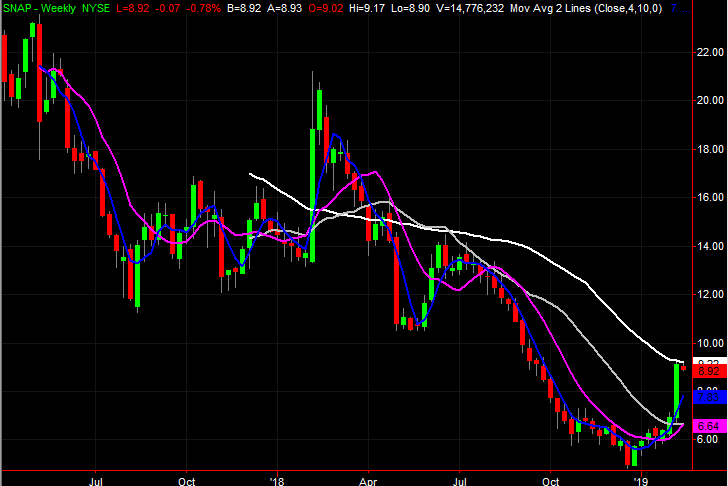
Some investors had altogether given up on Snapchat parent Snap (NYSE:SNAP), convinced there just wasn’t room for a third social media name in an environment that included Facebook (NASDAQ:FB) and Twitter (NYSE:TWTR). SNAP stock, between its February 2017 high hit shortly after its IPO and its low in December of last year, lost more than 80% of its value, while slowing user growth finally turned negative in the middle of 2018.

A glimmer of hope started to shine during the final quarter of last year. Its daily user total stabilized, and the habitual losses finally began to shrink.

It’s far from an ironclad turnaround, but it has been enough to spark over a 70% rebound from its December low.


Compare Brokers
U.S. Stocks: Coty (COTY)U.S. Stocks: Coty (COTY)

Coty (COTY)

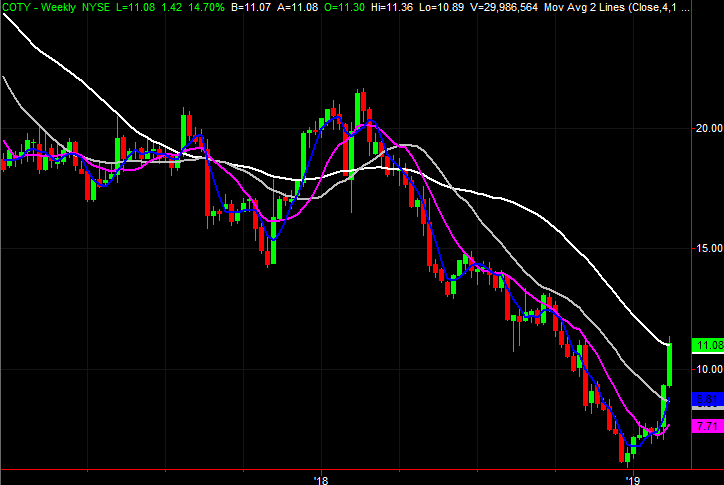
Like Snap, beauty company Coty (NYSE:COTY) is a name many investors had given up on. Shares fell 80% between early 2016 and the end of last year, mostly in response to an uninterrupted streak of declining revenue and shrinking profits.

It’s another name, however, that may have turned a corner nobody was expecting it to. COTY stock is up nearly 80% since its late December low, with most of that gain spurred by last quarter’s revenue and earnings. Both topped estimates.

Bonus: Several new executives — including a new CFO — have been named, setting the stage for some much-needed change in how the organization is managed. Bolstering the bullish argument is this week’s report that JAB Holding Co. is looking to take on a major equity stake in COTY stock at its current price.


Compare Brokers

Zynga (ZNGA)

Yes, the name behind popular casual gaming titles like Farmville, Words with Friends and Mafia Wars is still alive and kicking, even though its top games have largely run their course. In fact, Zynga (NASDAQ:ZNGA) CEO Frank Gibeau recently stated “Zynga’s turnaround is now complete,” referencing last year’s 5% improvement in revenue, leading into more earnings growth for this year.

The key has been a successful transition to mobile. Mobile engagement now make up more than 90% of game-play sessions, and Zynga has made a point of developing or acquiring the right games to engage players where they want to play. Its purchase of Gram and Small Giant gave it Merge Dragons and Empire of Puzzles, respectively, and both have been needed hits.

ZNGA stock is up 24% year-to-date after a lackluster 2018.


Compare Brokers
Nektar Therapeutics (NKTR)

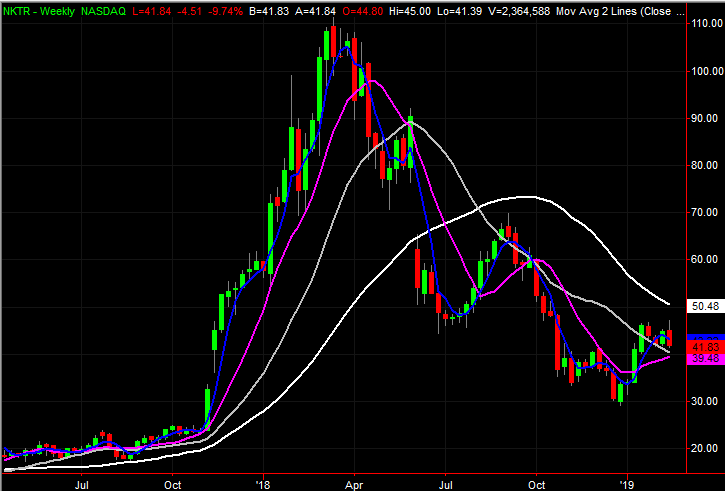
Despite Tuesday’s 9% setback, Nektar Therapeutics (NASDAQ:NKTR) shares are still up over 25% for the year so far, unwinding what has been a pretty miserable past few months.

The stock’s budding turnaround was largely prompted by hope for major progress this year. At the J.P. Morgan Healthcare conference held very early this year, Nektar announced several ambitious goals for the year, including the potential release of an abuse-deterrent opioid painkiller.

Investors also gave the company a little credit for the launch of a couple early-stage trials of autoimmune drug NKTR-358, which has drawn the interest of Eli Lilly (NYSE:LLY). Though its NKTR-214 looks to be a bust as a means of improving PD-1 treatments, the market may be thinking it treated NKTR stock too harshly in response.


Compare Brokers
Copart (CPRT)

Copart (NASDAQ:CPRT) isn’t exactly a household name, though it may have a place in some portfolios.

The company is predominantly an automobile auction outfit, able to handle sales of fleet vehicles as well as it can offload cars for individuals. It’s especially well known as a buyer of junked or un-drivable cars and a seller of salvageable parts.

It’s an interesting business. Whereas automobile manufacturers like Ford Motor (NYSE:F) or General Motors (NYSE:GM) are now facing the downside of 2015’s so-called “peak auto,” in many regards that’s proven beneficial for Copart. The cars those drivers replaced had to be dealt with somehow, and given that most of Copart’s auctions are consigned auctions, the company has a plentiful, low-to-no cost supply of inventory. Mostly though, it’s a non-cyclical business that’s expected to grow revenue by 10% this year.

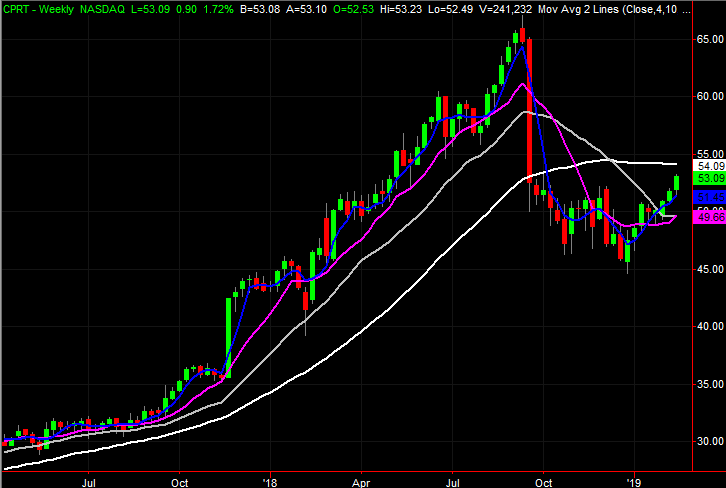
CPRT stock may only be up about 10% so far this year, but it was one of the hardest-hit U.S. stocks during the fourth quarter. That leaves plenty of room for more recovery.


Compare Brokers
U.S. Stocks: Dentsply Sirona (XRAY)U.S. Stocks: Dentsply Sirona (XRAY)

Dentsply Sirona (XRAY)

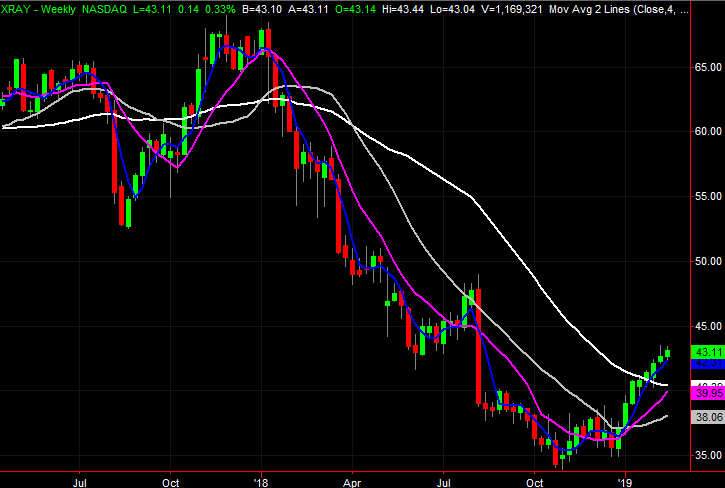
Dentsply Sirona (NASDAQ:XRAY) is a manufacturer of equipment and supplies for the dentistry industry … a boring lineup that has been reasonably consistent (even if not perfect) in terms of revenue growth.

That reliability did the stock little good for the better part of last year. Between its January high and October low, XRAY stock was cut in half, primarily due to deteriorating revenue and profits that most investors didn’t expect. By the time all was said and done, shares reached a seven-year low in the latter part of last year.

Though some degree of selling was certainly understandable, the bears arguably overshot. The 26% rebound since the end of October says investors are correcting their mistake in front of what should be a turnaround year. Analysts are only calling for about 2% sales growth in 2019, but that should be enough to improve per-share profits by 11%.


Compare Brokers
Chipotle Mexican Grill (CMG)

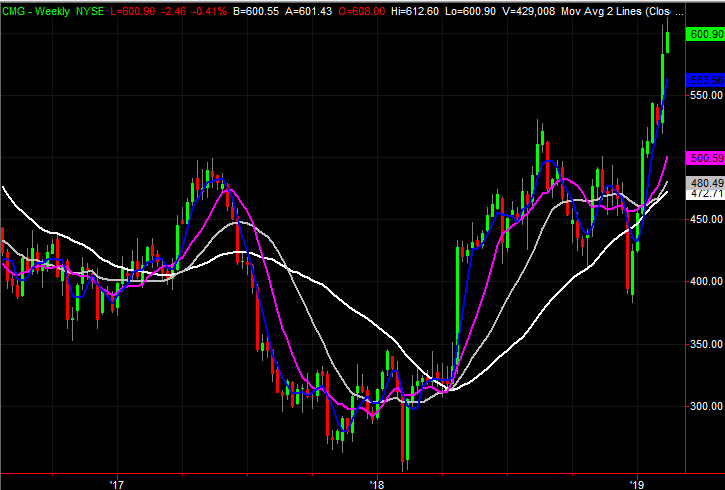
There was a time not too long ago when investors and consumers were wondering if Chipotle Mexican Grill (NYSE:CMG) would ever shrug off the impact of its 2015 E. coli debacle. Consumers were anything but quick to forget and forgive.

Last quarter’s results, however, suggest the new mix of management may be just what the struggling Tex-Mex eatery needed. Same-store sales improved 6.1%, while total revenue grew 10% thanks to store openings. Perhaps most compelling of all, however, was the earnings beat. Analysts were calling for a profit of $1.37 per share, but Chipotle reported income of $1.72 per share.

There’s still work to be done, to be sure. But, the work that’s been done so far has been enough to drive CMG stock to a 40% gain since the end of last year.


Compare Brokers
Bausch Health Companies (BHC)

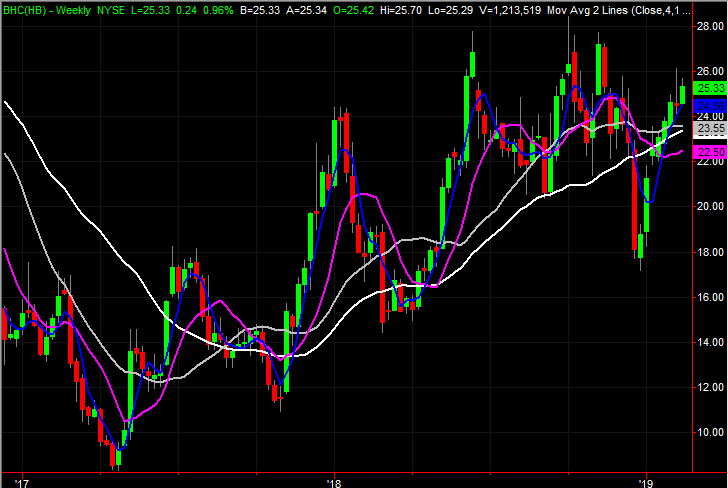
Bausch Health Companies (NYSE:BHC) has had a surprisingly tough past three years, although most of that pain played out while it was still called Valeant Pharmaceuticals … the company that racked up too much debt buying small-market drugs only to find political and societal pushback on its aggressive pricing policies at the worst possible time. With the proverbial party abruptly coming to a close in late 2015, Valeant shares lost roughly 97% of their value between July of 2015 and mid-2017.

It’s curious though. With very little fanfare despite measurable (albeit slow) fiscal progress, BHC stock has made nothing but higher lows and higher highs since the middle of 2017.

The 47% gain from its December low is exaggerated thanks to the steep pullback preceding that reversals, but the bullish high-low pattern has become pretty reliable.


Compare Brokers
Foot Locker (FL)

By the middle of 2017, the athletic apparel industry — and the athletic shoe industry in particular — was in trouble. Celebrity endorsements had become gratuitous and expensive, peaking right as consumers grew tired of paying big prices just to wear the same sneakers that stars like Kevin Durant and LeBron James wear.

Mike Packer, owner of Packer Shoes, explained the then-brewing dilemma a year earlier, saying “Over the last two years, companies have taken retro basketball and in-line product and spun off too many colors, too many stories. … Some of these models are being brought to market for their third or fourth time. It loses the allure.”

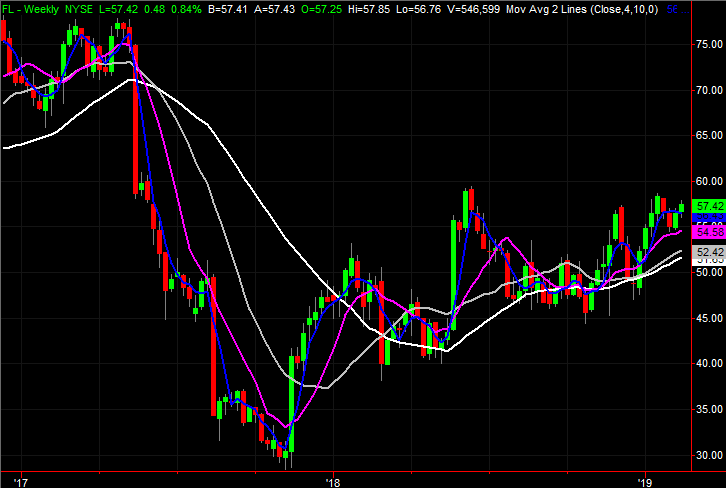
The shift took its toll on Foot Locker (NYSE:FL) stock. Shares tumbled more than 60% in 2017.

Things have been different in the meantime, however. Realizing it has to get back to basics and work strategically with key suppliers like Nike (NYSE:NKE), the retailer has hammered out enough improvements to drive a 20% gain from its December low. That latest bullish leg extends a quiet winning streak that now goes back a full year.

As of this writing, James Brumley held a long position in Foot Locker. You can learn more about James at his site, jamesbrumley.com, or follow him on Twitter

Tuesday, February 12, 2019

There Is No Slow Season for Florida Theme Parks Anymore

Early February used to be a safe time to hit up Central Florida's theme parks. The holiday-fueled families are back in school, operating hours get shorter, and outside of opportunistic locals and a few lingering snowbirds there has usually been plenty of elbow room at Disney's (NYSE:DIS) Disney World, Comcast's (NASDAQ:CMCSA) Universal Orlando, and SeaWorld Entertainment's (NYSE:SEAS) SeaWorld Orlando and Busch Gardens Tamps. 

The times are changing -- in a good way for shareholders, but possibly in a bad way for visitors who were hoping to get the year-round parks all to themselves this time of year. Festivals and seasonal events are packing the parks again, particularly on weekends, when locals have time to hit up the area attractions. 

The eight dry parks owned by Disney, Comcast, and SeaWorld attracted a combined 83.5 million visitors in 2017, according to industry watcher Themed Entertainment Association. The eight parks are among the 12 most visited in the U.S., and if they're off to a strong start in 2019, it's a good bet the rest of the industry will be following suit this year.  

Festival of the Arts garden in front of Spaceship Earth at Disney World's EPCOT.

Image source: Disney.

The festivals for the rest of us

The annual Mardi Gras celebration is kicking off at Universal Orlando this weekend with concerts, over-the-top parade floats, and beard-tossing float riders drawing guests to the Comcast-owned resort. A couple of I-4 exits away, SeaWorld Orlando's Seven Seas Food Festival also rolled out this weekend, with The Fray performing last night and Sugar Ray taking to the stage tonight.

If Disney's hungry neighbors to the north are bringing foodies, drinkers, and music buffs to town, it's a safe bet that Mickey Mouse is a step ahead of them. The 2019 International Festival of the Arts -- celebrating all art forms, including culinary -- has been raising the bar on the festival scene since Jan. 18. Unlike many of its peer weekend festivals, Disney's festival at Epcot is offered up daily, but it's at its busiest on weekends as Floridians flock to the food, wine, music, and art offerings.

The theme-park industry was already rolling ahead of the late winter season's festival run. Disney's domestic theme parks are getting guests to spend 7% more per capita than they were a year ago. Comcast's theme-parks division just wrapped up its fiscal year, with revenue rising 4% for both its latest quarter and all of 2018. SeaWorld Entertainment has scored an even more impressive turnaround, with theme-park attendance rising by at least 8% in each of last year's first three quarters. The stock has nearly doubled over the past year. 

Momentum is strong for the industry, and the growing popularity of festivals during a period that used to be the slow season is only helping to lift full-year results higher. There is no slow season for Florida theme parks anymore, and that's not necessarily a bad thing for an industry that's now justified in bankrolling new and better guest experiences. 

Monday, February 11, 2019

What the "Golden Staircase" Pattern Means for Gold Prices This Week

This site uses Akismet to reduce spam. Learn how your comment data is processed.

Peter KrauthPeter Krauth

Even though gold prices broke out in a big way to start the year, they've reached a lull in February. But this is actually a good thing.

Gold was up 3.1% in January alone and was up 10.3% between mid-November and the end of January.

Consolidation is not only to be expected; it's healthy. What we need to watch for now is how long it lasts and how much gold prices correct.

gold pricesIn the past week, the price of gold tested the $1,300 level, with buyers stepping in at $1,303 to provide support.
U.S. Federal Reserve Chair Jerome Powell's White House dinner with U.S. President Donald Trump on Monday (Feb. 5), the day before his State of the Union address, made economists uneasy about Fed independence.

And President Trump's speech on Tuesday (Feb. 6) provided little in the way of catalysts, other than possibly helping to buffer the dollar as traders grew weary of trade wars.

Looking at the movement of gold prices over the last six months, we can see it's following a unique pattern – what I coined the "golden staircase" years ago. That's when gold moves up, then sideways, and repeats the process in a discernable pattern over months and even years.

So despite a week that brought a relief rally in the dollar, gold still managed to hold its own as it contemplated a period of consolidation.

And given the robust buying from central banks in 2018 and institutional investors over the last several months, gold is looking solid indeed. I expect gold to continue to climb the golden staircase, and I'll lay out exactly where it's headed in my latest gold price prediction below…

Why Gold Prices Plateaued Last Week

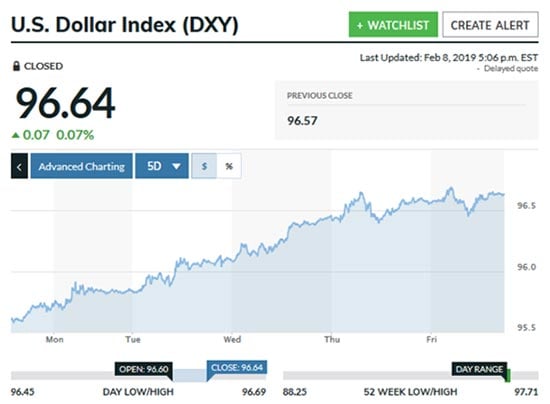
After closing around $1,317 the previous week, the price of gold started out Monday on a weaker tone as the U.S. Dollar Index (DXY) gained some steam. It climbed to 95.85 that morning and then moved sideways. Gold prices weakened initially but closed at $1,312.

Have 28 Seconds? You could make $2,353 – and you won't need to buy a single share of stock up front to collect this cash, or spend a nickel on anything. Click here to learn more…

Gold prices managed to hold around $1,314 through most of Tuesday, even as the DXY climbed above 96. But as the DXY sailed higher on Wednesday (Feb. 7) in the wake of the State of the Union address, gold succumbed and closed the day at $1,306.

Here's how the DXY looked last week…

gold

By Thursday (Feb. 8) the DXY had reclaimed the 96 level, but gold rebounded along with it, both favored as safe havens as markets sold off. Gold closed at $1,309.

And on Friday (Feb. 9), with flat stock markets and a sideways dollar, gold gained again, climbing steadily to close the week at $1,314.

But as I said before, this is a good sign. Gold prices consolidate before moving higher, and that's been the consistently bullish pattern for gold prices.

Here's how high gold prices can go…

How High the Golden Staircase Will Carry Gold Prices

Join the conversation. Click here to jump to comments…

Peter KrauthPeter Krauth

About the Author

Browse Peter's articles | View Peter's research services

Peter Krauth is the Resource Specialist for Money Map Press and has contributed some of the most popular and highly regarded investing articles on Money Morning. Peter is headquartered in resource-rich Canada, but he travels around the world to dig up the very best profit opportunity, whether it's in gold, silver, oil, coal, or even potash.

… Read full bio